
Blogs
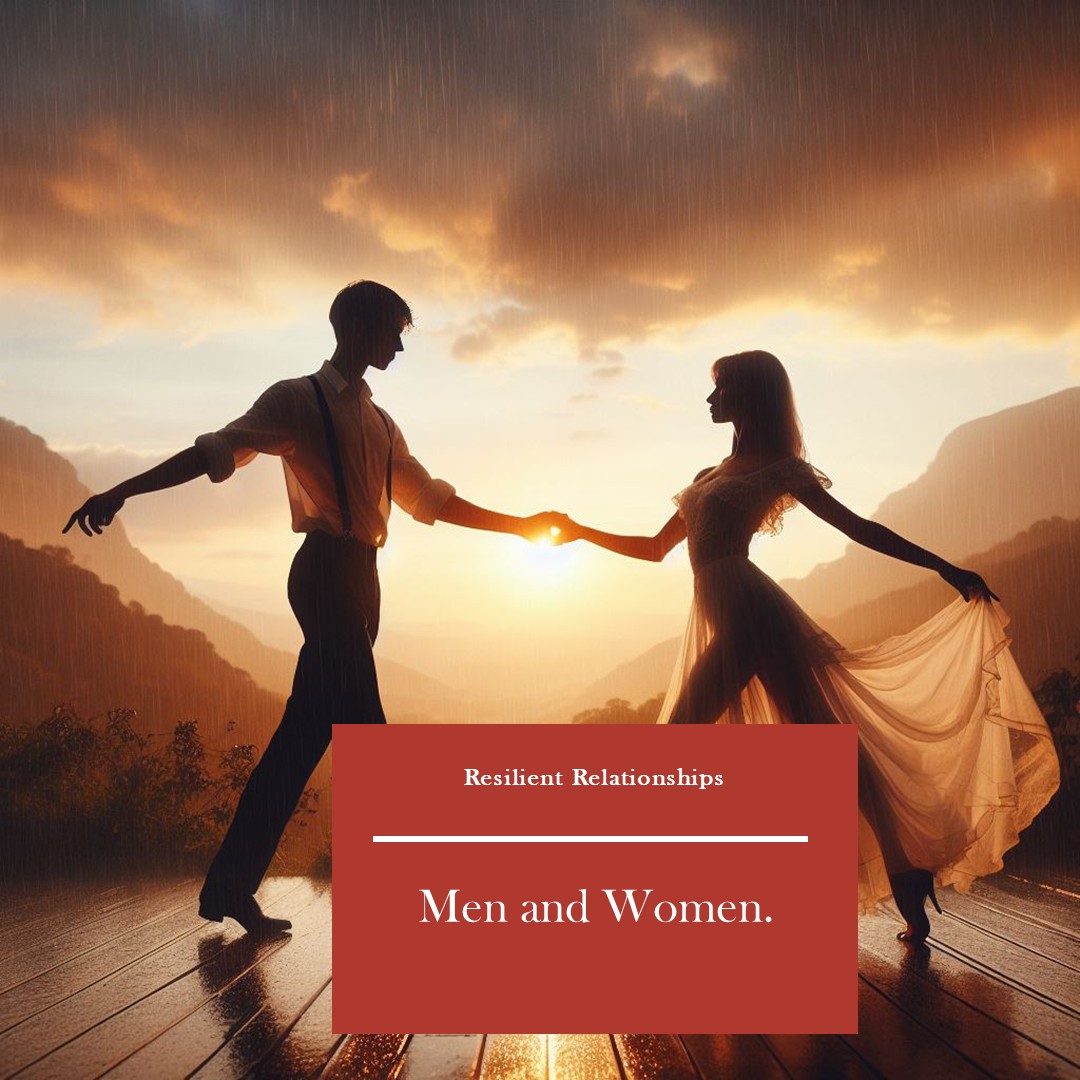
Men and Women
Men and Women

Have you ever stopped to wonder how much of who you are is truly you—and how much of it is simply what society has told you to be? From the way men are “supposed” to act to the way women are “expected” to feel, our lives are filled with roles and rules we rarely question.
There’s no shortage of books, posts, reels, and blogs on this topic. The world often seems divided into two categories—men and women—and I’ve consumed plenty of material about it. From books like Men Are from Mars, Women Are from Venus to countless discussions on how men are supposedly one way and women another, the narrative is everywhere: men are expected to be this, while women are expected to be that.
I don’t subscribe to the idea of rigid distinctions—it often turns into a “Men vs. Women” narrative. I also don’t believe in predefined gender roles or fixed patterns of behavior. While it’s true that we can speak in terms of two types of energy—masculine and feminine—it’s misleading to say that men should embody only masculine energy and women only feminine. Not only is that sexist, but it also goes against everything I teach in my coaching.
The truth is, we all carry both masculine and feminine energies, just in different proportions. And when I use the terms “masculine” and “feminine,” it’s purely for simplicity and clarity—it has nothing to do with biological gender.
One of my clients identifies as non-binary, which means they don’t limit themselves to the traditional categories of male or female. They don’t define themselves strictly as a man or a woman—and I found that perspective absolutely fascinating.
In fact, I find the concept of gender fluidity deeply interesting. I consider myself an ally—and perhaps even pansexual. Yes, I know what you might be thinking: but you’re married to a man! That’s true, but the reality is I fell in love with the person—not because he is a man, but because he is an incredible human Being!One of my close friends is a lesbian, and when she entered a relationship, her family strongly opposed it. She was heartbroken—until her sister stepped in and spoke to their grandmother. Her sister asked a simple yet profound question: “When we fall in love, what should we look for in a partner?” The grandmother replied, “A good person, a caring nature, someone who will stand by you through all the ups and downs of life.” Her sister then followed up, “So, should someone marry based only on physical appearance?” The grandmother immediately said, “Of course not. Looks are superficial. They fade over time, and the body changes.”
That’s when her sister gently asked, “Then why are we judging my sister’s partner based only on their body or genitals?” The clarity of that question shifted everything. The grandmother was convinced—and soon, the rest of the family followed her lead.
That said, the world still largely operates within the binary of men and women. From a young age, as little boys and girls, we’re taught how we’re supposed to behave, speak, walk, sit, and even spend our time. We’re conditioned to learn what’s considered acceptable for each gender and what isn’t. But this raises a powerful question: is all of this truly rooted in biology—or is it a social construct? Do we act the way we do because it’s innate to us, or because we’ve been taught to perform a certain way?
I was recently reading an article where the author framed things as “Men vs. Women”—claiming that men recharge in silence while women recharge through talking… that men prefer logic and problem-solving while women prefer emotions. I had to pause right there. Women like emotions?
This is exactly the kind of misconception that has been ingrained in us for so long, it almost feels unbelievable. We’re so conditioned to accept these generalizations without questioning them.
Take anger, for example. How many men do you know who are constantly angry, or at least comfortable expressing it openly? Society has decided that it’s acceptable for men to show anger freely. But here’s the irony—anger is an emotion! But men are often not allowed to express any emotion other than anger, and this forced suppression comes at a cost. What happens to all those unspoken feelings—sadness, fear, grief, or vulnerability? They don’t just disappear. Just like energy, emotions can neither be created nor destroyed; they simply transform. When they’re buried deep inside, they resurface in different, often destructive ways. Pain and grief, when unacknowledged, frequently mask themselves as anger, because that is the one emotion society has deemed “acceptable” for men to express.
I’m not denying that there are differences between men and women—of course there are. These differences show up not only physically and biologically, but also psychologically. However, to generalize men’s behavior versus women’s behavior oversimplifies the truth and doesn’t serve us.
What’s important to understand is that every one of us carries both energies within us, and we draw on them in different ways and at different levels.
There’s no absolute right or wrong here—it’s about awareness, balance, and authenticity.
So what does all of this really mean for us? To explore that, let’s take a step back and look at it from an evolutionary perspective.
When humans first evolved, specific roles were assigned to each gender—women were seen as the primary caregivers for children, while men were expected to hunt and provide food. This narrative has been repeated for centuries, and we even point to the animal kingdom as “proof.” But is that truly the full picture—or simply what we’ve been conditioned to believe?
I had a fascinating experience observing a pair of pigeons who built a nest and laid eggs right outside my window. Every night, the mother would sit on the eggs and protect them. Then, as if on cue, the father would arrive in the morning to relieve her. She would stretch her wings, forage for food, and later return to swap places again. Throughout the day, they alternated these roles. And once the chicks hatched, both parents would sometimes leave together to bring food back.
Of course, biology dictated that only the female could lay the egg. But after that, caregiving was a shared responsibility. It wasn’t as though the mother sat in the nest 24/7 while the father spent all his time outside searching for food. Yet isn’t that exactly what we’ve been led to believe happens in the animal kingdom—and the same justification that human society often uses to reinforce gender roles?
At the end of the day, love, authenticity, and human connection have nothing to do with rigid gender roles or outdated expectations. They have everything to do with seeing and accepting people as they are. Maybe the real evolution of our society begins not in biology, but in our willingness to let people be fully human.
Published by

Handcrafted by Coach Foundation | Copyright © 2023 Swati Mukherjee's Coaching. All Rights Reserved.